Learning how to remove pet hair from carpet can save a great deal of time if you have a dog, cat, or another shedding pet at home. Regular vacuuming helps, but it may not collect hair that has become twisted around carpet fibres or pushed deep into the pile. The best results usually come from loosening the hair first and vacuuming it afterward.
Quick answer: The most effective way to remove pet hair from carpet is to loosen embedded fur first with a rubber tool, carpet rake, or pet brush, then vacuum slowly in several directions. For edges and small areas, use rubber gloves or a lint roller. Always use gentle pressure and follow the carpet manufacturer’s care instructions.
The right method depends on your carpet type, how much your pet sheds, and how deeply the fur has become trapped. Below, we explain a complete cleaning process, quick methods for small areas, solutions for stubborn hair, and ways to reduce future buildup.
Why Is Pet Hair So Difficult to Remove from Carpet?
Pet hair does not always remain loose on the carpet surface. Fine strands can settle between carpet fibres, while movement across the floor can push them deeper.
Several factors make pet hair difficult to collect.
Static Attraction
Pet hair can cling to carpet fibres because of static electricity, particularly in dry indoor conditions. This is one reason a vacuum may pass over visible hair without collecting all of it.
Carpet Pile
High-pile and thick carpets have more space between their fibres, allowing hair to become buried below the surface.
Short, low-pile carpets are generally easier to clean because the hair has fewer places to hide.
Foot Traffic
Walking over loose pet fur pushes it deeper into the carpet. Areas around sofas, beds, hallways, and doorways can therefore collect more embedded hair.
Pet Sleeping Areas
Dogs and cats often leave much larger amounts of fur where they regularly sleep or rest. These areas may require manual hair removal before vacuuming.
Hair Type
Long pet hair may wrap around carpet fibres and vacuum brush rolls. Very fine or short hair can be harder to see and may cling tightly to the carpet.
The solution is not always stronger suction. In many cases, the hair needs to be physically loosened before the vacuum can collect it.
What Is the Best Way to Remove Pet Hair from Carpet?
For most homes, we recommend a simple three-stage approach:
- Loosen the trapped hair.
- Gather heavy clumps manually.
- Vacuum slowly in more than one direction.
This works better than repeatedly running a vacuum over the same area without first releasing embedded hair.
Tools You Can Use to Remove Pet Hair
You do not need every tool listed below. Choose one or two based on your carpet and the amount of fur.
| Tool | Best For | Main Advantage | Limitation |
|---|---|---|---|
| Vacuum with pet attachment | Whole rooms | Fast and practical | May miss deeply embedded hair |
| Rubber squeegee | Medium to large areas | Pulls hair into piles | Requires manual effort |
| Rubber gloves | Small areas and edges | Cheap and easy | Slow for large rooms |
| Carpet rake | Thick or heavily covered carpet | Reaches trapped hair | Must be used gently |
| Pet hair brush | Targeted cleaning | Good control | Not ideal for whole rooms |
| Lint roller | Small visible patches | Very quick | Uses many adhesive sheets |
| Crevice attachment | Edges and corners | Reaches narrow areas | Not suitable for large surfaces |
For a heavily covered carpet, combining a rubber or raking tool with a vacuum usually produces better results than using only one method.
How to Remove Pet Hair from Carpet Step by Step
Step 1: Clear the Carpet
Before cleaning, remove:
- Pet toys
- Shoes
- Floor cushions
- Small furniture
- Pet bowls
- Loose objects
Move lightweight furniture if possible so you can reach areas where fur tends to collect.
Pay particular attention to the carpet underneath sofas, around pet beds, beside skirting boards or baseboards, and underneath tables.
Step 2: Check Your Carpet Type
Before using any brush, rake, moisture, or cleaning product, identify what kind of carpet you have.
A normal synthetic cut-pile carpet can usually tolerate more brushing than a delicate carpet.
Be more careful with:
- Wool carpets
- Handmade rugs
- Loop-pile carpet
- Berber-style carpet
- Long shag carpet
- Antique rugs
- Carpets with loose or damaged fibres
Aggressive scraping can pull loops or disturb the surface.
When unsure, test your chosen tool on a small hidden section first.
Step 3: Loosen Embedded Pet Hair
This is one of the most important steps.
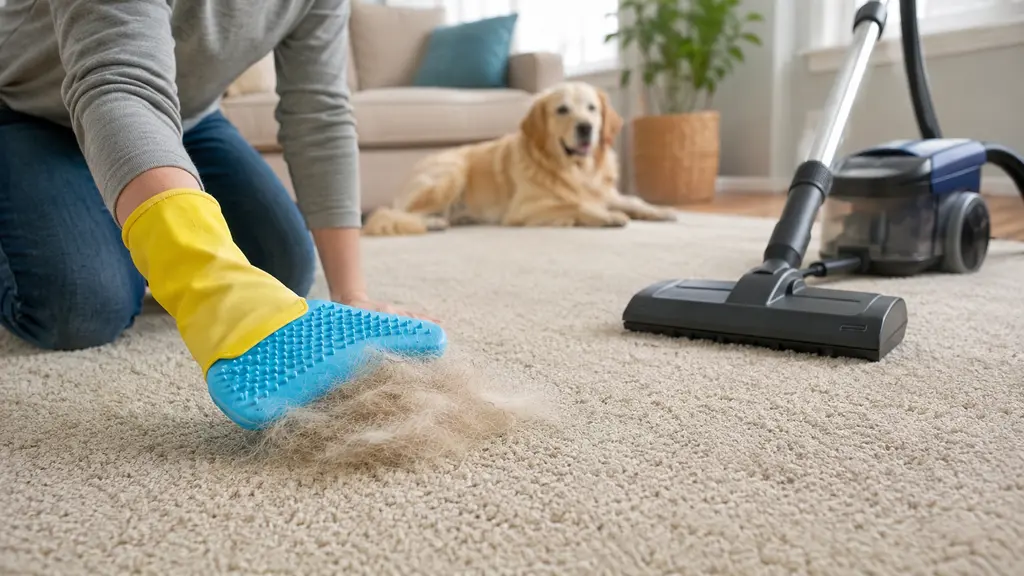
Choose a rubber squeegee, rubber glove, suitable carpet rake, or pet hair brush. Move it gently across the carpet using short strokes.
Instead of trying to collect every individual hair, work the fur into small piles.
You may be surprised by how much hair appears even after the carpet has already been vacuumed.
Work in Sections
Divide a large room mentally into smaller sections.
For example:
- Clean a one-metre or three-foot section.
- Gather the loosened hair.
- Move to the next section.
Working systematically prevents you from repeatedly cleaning the same area while missing others.
Step 4: Pick Up Large Hair Clumps
Once you have loosened the fur, pick up the largest clumps by hand or with a paper towel.
This keeps large amounts of hair from entering your vacuum at once and reduces the chance of hair wrapping around the brush roll.
Step 5: Vacuum Slowly
Now vacuum the carpet.
Avoid making very fast passes. Give the brush and suction enough time to work across the fibres.
Start in one direction and use overlapping passes.
Then change direction.
For example, if your first pass runs from north to south across the room, make your second pass from east to west.
Changing direction can expose hair that was lying against the carpet pile during your first pass.
Step 6: Check Corners and Carpet Edges
Pet hair often gathers where the main vacuum head cannot reach.
Use a crevice attachment around:
- Walls
- Baseboards or skirting boards
- Furniture legs
- Door frames
- Stairs
- Under furniture
- Around pet beds
Rubber gloves can also work well on these smaller areas.
Step 7: Check the Carpet Again
Look at the carpet from different angles.
Remaining pet hair is often easier to see when light comes across the carpet instead of directly from above.
Run your hand gently across suspicious areas. If hair is still coming free, repeat the loosening and vacuuming process only in those areas rather than cleaning the entire room again.
Step 8: Clean the Vacuum
Heavy pet hair can quickly affect vacuum performance.
After cleaning, inspect:
- Brush roll
- Dust container or vacuum bag
- Filters
- Hose openings
- Pet hair attachments
Remove wrapped hair according to the vacuum manufacturer’s instructions.
A vacuum that has lost airflow will make the next cleaning session much harder.
How to Remove Pet Hair from Carpet Without a Vacuum
A vacuum is convenient, but it is not your only option.
If you do not have one available, several manual methods can remove a surprising amount of fur.

Method 1: Use Rubber Gloves
Put on clean household rubber gloves and run your hands across the carpet.
Use short strokes in one direction. Hair should begin collecting together.
Pick up each clump and continue.
A glove that is only very lightly damp can sometimes help collect loose hair, but avoid making the carpet wet.
This method is especially useful for:
- Stairs
- Small rugs
- Carpet edges
- Areas under furniture
- Pet sleeping spots
Method 2: Use a Rubber Squeegee
A clean rubber squeegee can be very effective over larger sections.
Pull it slowly toward yourself using short strokes. The rubber edge helps bring loose and embedded hairs together.
Collect the resulting piles by hand.
Do not apply heavy pressure, especially on delicate or looped carpets.
Method 3: Use a Carpet Rake
A carpet rake can help when fur is deeply embedded.
Gently pull the rake across the carpet instead of digging it into the fibres.
Once the fur has collected into clumps, pick them up manually.
Check that the rake is suitable for your specific carpet before use.
Method 4: Use a Lint Roller
A large lint roller can remove visible fur from small carpet sections.
It works particularly well around:
- Pet beds
- Stairs
- Rugs
- Furniture edges
- Small patches
However, a lint roller becomes inefficient for an entire room because its adhesive sheets fill quickly.
How to Remove Stubborn or Deeply Embedded Pet Hair
Sometimes normal vacuuming and one pass with a rubber tool are not enough.
For heavily embedded hair, use a layered cleaning method.
First Pass: Rubber Tool or Carpet Rake
Loosen as much fur as possible.
Second Pass: Vacuum Across the Carpet
Vacuum slowly in one direction.
Third Pass: Change Direction
Turn 90 degrees and vacuum again.
Fourth Pass: Detail Problem Areas
Use a handheld pet attachment or rubber glove on the areas that still contain hair.
Fifth Pass: Check the Vacuum Brush
If the vacuum suddenly becomes less effective, stop and check whether hair has wrapped around its brush roll.
Do not continue making extra passes with a clogged machine.
Best Pet Hair Removal Method by Carpet Type
Different carpets need different levels of care.
| Carpet Type | Suggested Approach | Important Caution |
| Low-pile synthetic carpet | Rubber tool + vacuum | Avoid unnecessary wetting |
| Medium-pile carpet | Pet brush/rubber tool + vacuum | Work in several directions |
| High-pile carpet | Gentle rake + vacuum | Do not pull fibres aggressively |
| Shag carpet | Carefully separate surface fur + suitable vacuum | Check manufacturer instructions |
| Loop/Berber carpet | Vacuum + gentle rubber tool | Avoid tools that can catch loops |
| Wool carpet | Gentle vacuuming and approved tools | Avoid unapproved chemicals or harsh brushing |
| Area rug | Vacuum and manual rubber tool | Check care label, especially for handmade rugs |
The safest rule is simple: when you are unsure about a carpet material, begin with the least aggressive dry method.
How to Remove Dog Hair from Carpet
Dog hair can range from long, soft fur to very short, stiff hairs.
Long-haired dogs often leave visible clumps that can be collected with a carpet rake or rubber tool before vacuuming.
Short dog hairs can sometimes work deeper into the carpet pile. For these, use short rubber-tool strokes followed by slow vacuuming from different directions.
Give extra attention to:
- Areas beside dog beds
- Sofa surroundings
- Main walking paths
- Entrances
- Places where the dog regularly lies down
Regular grooming can significantly reduce the amount of loose fur reaching these areas.
How to Remove Cat Hair from Carpet
Cat hair can be fine, light, and difficult to see until a large amount has collected.
A rubber glove can be useful for small areas because it gathers fine hairs into more visible clumps.
For larger carpet areas:
- Use a rubber squeegee or suitable pet hair tool.
- Collect the loose fur.
- Vacuum slowly.
- Repeat around furniture and resting areas.
Look carefully underneath furniture and close to walls because cats often sleep in quieter, sheltered spots.
How to Remove Pet Hair from Carpeted Stairs
Carpeted stairs require a different approach because a normal upright vacuum may be difficult to control.
Start at the top and work downward.
Use:
- A handheld vacuum
- Pet hair attachment
- Rubber glove
- Small rubber brush
- Suitable stair attachment
Pay close attention to the point where the horizontal tread meets the vertical riser. Hair often becomes trapped along this edge.
Always work in a safe position and avoid leaving tools where someone could trip over them.
How to Remove Pet Hair Around Carpet Edges
Hair around carpet edges can remain even after the centre of the room looks clean.
Use a crevice tool first.
If hair remains, gently gather it with:
- A rubber glove
- Small rubber brush
- Pet hair tool
Avoid scraping hard objects against the edge because you could damage fibres or separate the carpet from its fitted position.
Should You Use Baking Soda to Remove Pet Hair?
Baking soda is often suggested for carpets, but it is important to understand what it actually does.
Baking soda does not directly pull embedded pet hair out of carpet fibres.
It is mainly used as a household deodorising powder. If the real problem is fur, a rubber tool, carpet rake, pet brush, or vacuum will usually provide a more direct solution.
There is also no need to spread powder over an entire carpet simply to remove hair.
If you plan to use any powder-based carpet product, first check both your carpet manufacturer’s guidance and your vacuum manufacturer’s instructions.
Should You Use Fabric Softener on Carpet to Remove Pet Hair?
Some household tips suggest spraying diluted fabric softener on carpet to reduce static.
We do not recommend making this your first method.
Adding unnecessary products can leave residue, change the carpet’s feel, or create another cleaning problem if too much is applied.
For pet hair alone, begin with dry methods such as:
- Rubber tools
- Carpet rakes
- Pet brushes
- Vacuuming
If you use any liquid or carpet treatment, make sure it is suitable for your carpet and test it in an unseen area first.
Pet Hair Removal vs Carpet Deep Cleaning
Pet hair removal and carpet washing are not the same task.
| Pet Hair Removal | Deep Carpet Cleaning |
| Removes fur from carpet fibres | Removes soil, stains, and residues |
| Usually starts as a dry process | Often uses water or cleaning solution |
| Uses vacuum, rubber tools, rakes, or brushes | Uses extraction or carpet-cleaning equipment |
| Can be performed frequently | Usually needed less frequently |
| Targets visible and embedded hair | Targets deeper overall carpet contamination |
If your carpet only has pet hair, soaking or washing it may be unnecessary.
Remove as much loose and embedded fur as possible before deep cleaning. This prevents large amounts of hair from becoming wet and harder to collect during the cleaning process.
Common Mistakes When Removing Pet Hair from Carpet
Vacuuming Too Fast
Fast passes may collect surface dirt while leaving embedded hair behind.
Move slowly and make overlapping passes.
Using Too Much Force
Scraping aggressively can damage carpet fibres, particularly on loop, wool, shag, or delicate carpets.
Use repeated gentle strokes instead.
Starting With Water
Water is usually unnecessary when your only problem is pet hair.
Dry removal should normally come first.
Ignoring Carpet Edges
The centre of the room may look clean while significant amounts of hair remain beside walls and furniture.
Use a crevice attachment during every detailed cleaning.
Never Cleaning the Vacuum Brush
Wrapped pet hair can reduce how effectively a rotating brush works.
Inspect it regularly.
Filling the Vacuum Container Too Much
A full dust container or bag can affect airflow on many vacuum designs.
Empty it as required while cleaning.
Using the Wrong Tool on Loop Carpet
Sharp or aggressive rakes may catch loops.
Choose a gentler method and follow the carpet manufacturer’s instructions.
Trying to Solve Every Carpet Problem at Once
Pet hair, stains, urine, and odours are different problems.
Remove dry fur first. Treat stains and odours separately with products and methods suitable for the specific carpet.
How to Prevent Pet Hair from Building Up in Carpet
The easiest pet hair to remove is hair that never becomes deeply embedded.
Vacuum High-Use Areas More Often
You may not need to clean every room equally.
Focus more often on:
- Pet sleeping areas
- Main walkways
- Living rooms
- Carpet near sofas
- Stairs
- Bedrooms where pets are allowed
Small, frequent cleaning sessions are usually easier than removing weeks of buildup at once.
Groom Your Pet Regularly
Brushing your dog or cat collects loose hair before it reaches the floor.
The correct grooming routine depends on your pet’s breed, coat, and health, so follow suitable grooming advice for your animal.
Wash Pet Bedding
Pet beds and blankets can hold a large amount of fur.
Cleaning them regularly helps prevent loose hair from continuously transferring back onto your carpet.
Check the item’s washing instructions before cleaning.
Use Washable Throws
If your pet regularly sleeps on one part of the sofa or floor, a washable throw or pet blanket can contain some of the shedding.
It is easier to clean a removable covering than an entire carpet.
Deal With Heavy Shedding Early
Seasonal shedding can quickly increase the amount of fur around a home.
During these periods, increase both grooming and vacuuming frequency instead of waiting for the hair to become deeply embedded.
A Simple Pet Hair Cleaning Routine
You do not need to perform a deep carpet hair-removal process every day.
A practical routine might look like this:
Quick Cleaning
Vacuum visible hair from the areas your pet uses most.
Weekly Detailed Cleaning
Move light furniture, vacuum edges, clean around pet beds, and check stairs.
When Hair Becomes Embedded
Use a rubber tool or suitable carpet rake before vacuuming.
Periodically
Inspect vacuum filters, hoses, attachments, and brush rolls according to the appliance instructions.
The ideal schedule depends on the number of pets, their coat type, the amount they shed, and how much carpet you have.
When Should You Consider Professional Carpet Cleaning?
Removing hair at home is usually manageable, but professional carpet care can be useful when the problem involves more than shedding.
Consider professional help when:
- The carpet still looks dirty after thorough vacuuming.
- Pet odours remain.
- Old stains are present.
- Pet accidents have soaked into the carpet.
- Large areas have severe buildup.
- You have delicate or expensive carpet and are unsure how to clean it.
- Your carpet requires periodic professional cleaning under its care instructions.
Remember that removing visible pet hair and treating pet urine or other biological stains require different cleaning steps.
For example, do not automatically apply heat, household chemicals, or large amounts of water to a pet accident without first checking the correct treatment for the carpet.
Practical Tips for Faster Pet Hair Removal
A few small changes can make the process easier.
- Work from one side of the room to the other. This helps you see which areas are complete.
- Clean pet sleeping areas first. They usually contain the most hair.
- Remove large clumps before vacuuming. This reduces unnecessary load on the vacuum.
- Use cross-direction vacuuming. A second direction can expose trapped fur.
- Use smaller tools for edges. A full-size vacuum head cannot reach every area.
- Clean tools as you work. A brush covered in fur quickly becomes less effective.
- Use good lighting. Hair is often easier to see when light reaches the carpet from the side.
- Start gently. Increase effort only if the carpet can safely handle the tool.
Frequently Asked Questions
What is the easiest way to remove pet hair from carpet?
For light pet hair, vacuum slowly using overlapping passes. If the hair is stuck to the carpet, loosen it first with a clean rubber glove, rubber squeegee, pet hair brush, or suitable carpet rake, then vacuum the loosened fur.
How do you get deeply embedded dog hair out of carpet?
Use a carpet-safe rubber tool or rake to bring the embedded dog hair toward the surface. Remove large clumps, then vacuum slowly in several directions. Repeat only on the areas where hair remains.
How do you remove cat hair from carpet without a vacuum?
Rubber gloves are useful for small areas. Run a clean glove across the carpet in short strokes until the fine hair forms clumps. A rubber squeegee or carpet rake can be more practical for larger areas.
Why is my vacuum not picking up pet hair?
The hair may be tangled around carpet fibres rather than sitting loose on the surface. Your vacuum may also have a full container, dirty filter, blocked hose, wrapped brush roll, incorrect height setting, or unsuitable attachment.
Check the machine according to its manufacturer’s instructions and loosen embedded hair manually before trying again.
Does a rubber squeegee really remove pet hair from carpet?
It can also work very well on many carpets. The rubber edge creates friction against the carpet surface and helps bring loose hairs together into clumps that can be picked up or vacuumed.
Use light pressure and avoid aggressive rubbing on delicate carpets.
Can I use rubber gloves to remove dog hair?
Yes. Rubber gloves are particularly useful for small carpet areas, stairs, edges, and places where your pet regularly sleeps.
They are inexpensive but can be time-consuming for an entire room.
Does baking soda remove pet hair?
Not directly. Baking soda does not replace the physical action needed to pull hair from carpet fibres. For fur removal, rubber tools, carpet brushes, rakes, and vacuuming are more useful.
Should I wet the carpet before removing pet hair?
Usually not. When the main problem is dry pet hair, remove it while the carpet is dry. Wetting the carpet can make the process more complicated and is unnecessary for normal fur removal.
Can a lint roller remove pet hair from carpet?
Yes, particularly from small patches, stairs, rug edges, or areas around pet beds. It is less practical for cleaning a full room because the adhesive sheets can fill with hair very quickly.
What is the best pet hair remover for thick carpet?
A carpet-safe rake or rubber pet hair tool followed by a suitable vacuum can work well. However, thick carpets vary widely, so check the carpet care instructions before using an aggressive raking tool.
How often should you vacuum carpet if you have pets?
There is no single schedule that fits every household. Homes with several pets or heavy-shedding animals may need high-use areas vacuumed several times a week, while lower-use rooms may require less frequent cleaning.
The goal is to collect loose fur before everyday movement pushes it deeper into the carpet.
Can professional carpet cleaning remove embedded pet hair?
Professional carpet cleaning can help with heavily soiled carpets, but loose pet hair should ideally be removed as thoroughly as possible before wet cleaning. A professional cleaner may use commercial vacuuming and agitation equipment as part of the preparation process.
What if pet hair is mixed with urine stains or odour?
Treat the problems separately. First remove as much dry hair as possible. Then use a carpet-safe method designed for the stain or odour.
Pet urine can penetrate below the visible carpet surface, so persistent smells or large accidents may require professional treatment.
Conclusion
Knowing how to remove pet hair from carpet is mainly about using the right order of cleaning. Instead of repeatedly vacuuming stubborn fur, loosen embedded hair first with a carpet-safe rubber tool, pet brush, or suitable rake. Collect the larger clumps, then vacuum slowly in multiple directions and finish around edges and corners.
For everyday shedding, regular vacuuming may be enough. For heavier buildup, combining manual agitation with vacuuming produces better results. Take extra care with wool, loop-pile, shag, handmade, or other delicate carpets, and always follow the manufacturer’s care instructions when you are unsure.
Most importantly, do not wait until large amounts of fur become deeply trapped. Regular pet grooming, cleaning pet bedding, and frequent attention to your pet’s favourite areas can also make future carpet cleaning much faster and easier.
Also read: Can Dogs Eat Bananas? The Ultimate Guide for Dog Lovers
