Finding the best vacuum cleaner for pet hairs is not simply a matter of choosing the vacuum with the highest advertised suction power. Pet hair behaves differently from ordinary dust. Fine cat hair can cling to upholstery, long dog hair can wrap around brush rolls, and short coarse fur can work deep into carpet fibers where a basic vacuum may struggle to remove it.
For most households, we consider the Dyson V15 Detect one of the strongest all-round choices for pet hair because it combines excellent carpet hair pickup, strong filtration, cordless convenience, and useful tools for furniture and difficult areas. In current laboratory testing, RTINGS gives the Dyson V15 Detect a 9.5 score for pet-hair pickup and identifies it as its best overall vacuum for pet hair.
However, there is no single vacuum that is perfect for every pet owner. A large home with several dogs, thick carpeting, and constant shedding may benefit more from a powerful corded upright or canister vacuum. A small apartment with mostly hard flooring may be better served by a lightweight cordless model. Homes where allergy control matters may benefit from a sealed, bagged vacuum that minimizes dust exposure during disposal.
That means the real question is not simply, “Which vacuum is best?” We should ask, which vacuum is best for our pets, flooring, furniture, cleaning habits, and budget?
In this guide, we examine the most important features, compare leading vacuum types and current models, explain how pet-hair technology works, and show how we can choose a machine that keeps floors, rugs, sofas, stairs, and other surfaces cleaner with less effort.
Best Vacuum Cleaner for Pet Hairs: Quick Answer
For readers who want a fast recommendation, the following models provide a strong starting point. Prices and availability can change, so we recommend checking the latest Amazon listing before purchasing.
| Vacuum Cleaner | Best For | Why We Recommend It | Amazon Buying Link |
|---|---|---|---|
| Dyson V15 Detect | Best overall | Excellent pet-hair pickup, strong suction, versatile attachments, and cordless convenience | Buy Dyson V15 Detect on Amazon |
| Dyson Gen5detect | Best premium cordless | Powerful cordless performance, advanced filtration, long runtime, and excellent floor cleaning | Buy Dyson Gen5detect on Amazon |
| Miele Complete C3 Cat & Dog | Best bagged canister | Excellent pet-hair pickup, large capacity, strong filtration, and clean bagged disposal | Buy Miele Complete C3 Cat & Dog on Amazon |
| Shark Stratos AZ3002 | Best corded upright | Strong carpet cleaning, anti-hair-wrap technology, and continuous corded power | Buy Shark Stratos AZ3002 on Amazon |
| Shark Stratos Cordless IZ862H | Best for long hair | Anti-hair-wrap brush system, flexible wand, and good performance on pet and human hair | Buy Shark Stratos IZ862H on Amazon |
| Shark PowerDetect Cordless IP1251 | Best Shark cordless alternative | Automatic cleaning adjustments, flexible design, and strong multi-surface performance | Buy Shark PowerDetect Cordless on Amazon |
| Bissell PowerClean FurFinder | Best value cordless option | Pet-focused cleaning tools, convenient cordless design, and a more affordable price point | Buy Bissell PowerClean FurFinder on Amazon |
| Roborock Saros 20 | Best robot vacuum for pet hair | Automated daily cleaning, dual anti-tangle technology, and strong pet-hair removal | Buy Roborock Saros 20 on Amazon |
Current testing does not produce one universal winner. RTINGS ranks the Dyson V15 Detect as its best tested pet-hair vacuum, while WIRED currently recommends the more powerful Dyson Gen5Detect as its leading cordless pet-hair choice. TechRadar’s recent testing favors the Shark PowerDetect Cordless as its best overall option.
The differences illustrate an important point: the best vacuum depends heavily on how and where we use it.
Why Pet Hair Requires a Specialized Vacuum Cleaner
Ordinary household debris usually sits on or near the surface. Pet hair can behave very differently.
Dog and cat hair may:
- Work deep into carpet fibers.
- Become embedded in fabric furniture.
- Wrap tightly around rotating brushes.
- Collect along skirting boards and room edges.
- Float underneath furniture.
- Stick to rugs through static electricity.
- Accumulate on stairs.
- Mix with dust, skin flakes and pet dander.
- Clog poorly designed vacuum pathways.
- Quickly fill small dust containers.
Short-haired animals can be surprisingly difficult to clean after because their stiff hairs may become lodged inside fabric. Long-haired pets create another problem: strands often wind themselves around brush rolls and require frequent cutting or removal.
A vacuum designed with pet households in mind therefore needs more than powerful suction.
The Role of Suction
Suction creates the airflow needed to lift hair and debris into the vacuum.
Strong suction matters particularly for:
- Deep carpets.
- Rugs.
- Carpeted stairs.
- Cracks between floorboards.
- Large amounts of loose fur.
However, suction alone does not determine cleaning effectiveness. A poorly designed cleaner head may leave embedded fur behind even when the motor is powerful.
The Importance of Brush-Roll Agitation
On carpet, a rotating brush helps disturb the carpet pile so embedded hair can be released.
This is why we usually prefer a powered cleaner head when choosing the best vacuum cleaner for pet hairs in carpeted homes.
A good brush roll should agitate the fibers without constantly becoming covered in wrapped hair.
Why Anti-Tangle Technology Matters
Hair wrapping is one of the biggest frustrations associated with vacuuming after pets.
Modern anti-tangle systems use various designs to move hair away from the brush roll and toward the suction pathway. These systems are particularly valuable when we have:
- Long-haired dogs.
- Long-haired cats.
- Multiple pets.
- Household members with long human hair.
NBC’s pet-vacuum guidance similarly emphasizes features such as rotating brush rolls, anti-tangle cleaner heads and adequate dust capacity when choosing a pet-hair machine.
Best Vacuum Cleaner for Pet Hairs by Home Type
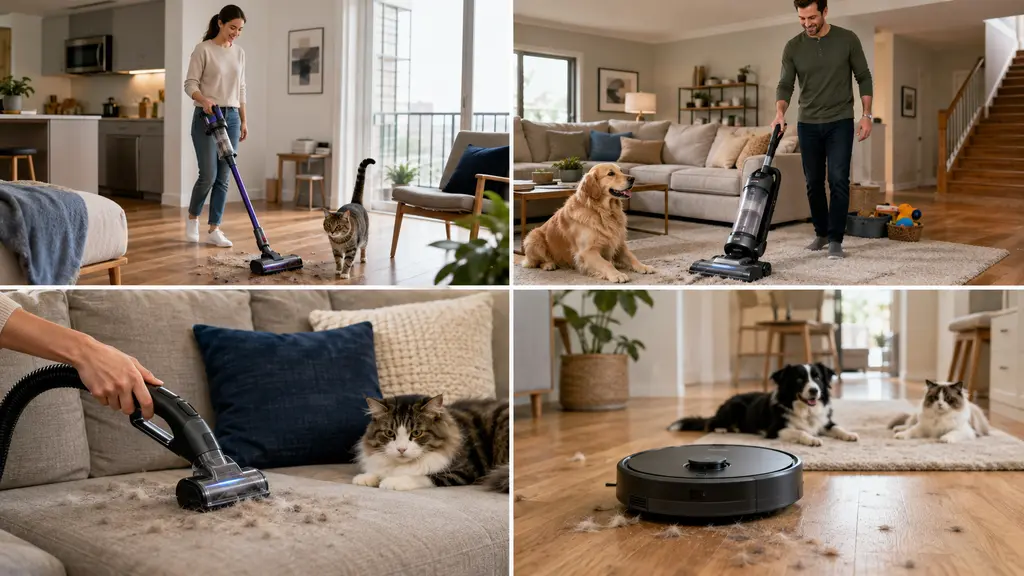
Different homes create very different cleaning challenges.
Small Apartments
For smaller homes, a cordless stick vacuum often makes the most sense.
We usually do not need an extremely large dust bag, extra-long cable or bulky canister. Instead, easy storage and quick access become more valuable.
A cordless model can be ideal because we can:
- Pick it up immediately when we notice fur.
- Clean several rooms without changing sockets.
- Convert it into a handheld cleaner.
- Reach sofas and stairs easily.
- Store it in a relatively small space.
The Dyson V15 Detect and similar premium cordless machines are particularly versatile in this environment.
Large Houses
Large homes create different priorities.
Runtime, dust capacity, cleaning range and sustained suction become more important. If we have several floors or heavily carpeted rooms, a corded upright or canister vacuum may be preferable.
A corded machine provides effectively unlimited cleaning time. We do not need to stop because the battery is depleted.
Multi-Pet Homes
Households with two, three or more shedding pets should prioritize:
- Strong brush-roll agitation.
- Anti-hair-wrap technology.
- Large dust capacity.
- Easy filter cleaning or replacement.
- Powerful upholstery tools.
- Consistent suction.
- Easy maintenance.
A small dustbin can become frustrating very quickly in a home with several dogs or cats.
Homes With Mostly Carpets
For carpet-heavy homes, we should prioritize the floor head above almost everything else.
A powered brush roll helps remove fur that suction alone may not release.
Corded upright vacuums remain especially useful for this task because their larger cleaner heads and continuous power are well suited to deep carpet cleaning.
Homes With Mostly Hard Flooring
Hard floors need a different approach.
Pet hair generally sits on the surface rather than becoming embedded. The challenge is collecting it without pushing lightweight strands away from the cleaner head.
Soft roller heads can work particularly well on:
- Hardwood.
- Laminate.
- Vinyl.
- Tile.
- Smooth sealed floors.
We should also look for a machine that handles edges well, since fur tends to accumulate along walls.
How We Evaluate the Best Vacuum Cleaner for Pet Hairs
When comparing pet vacuums, we should assess the entire cleaning system rather than focusing on a single specification.

1. Pet-Hair Pickup
The first question is obvious: does the vacuum actually remove fur?
A good pet vacuum should perform well on:
- Low-pile carpet.
- Medium-pile carpet.
- Rugs.
- Hard flooring.
- Upholstery.
Performance on furniture is especially important because floor-cleaning tests do not necessarily predict how well a vacuum will clean a fabric sofa.
2. Hair-Wrap Resistance
A cleaner that removes hair from the carpet but transfers all of it onto its brush roll has only solved half the problem.
Anti-tangle performance reduces maintenance and keeps the brush operating efficiently.
3. Filtration
Pet households collect more than visible fur.
Vacuumed material can include:
- Fine dust.
- Skin flakes.
- Pollen carried indoors.
- Pet dander.
- Other microscopic particles.
We therefore prefer effective filtration, particularly when someone in the household is sensitive to airborne allergens.
4. Sealed Construction
A filter is only as useful as the system surrounding it.
If air can leak around the filter, very fine particles may escape back into the room. A well-sealed vacuum directs exhaust air through its filtration system before releasing it.
5. Furniture Cleaning
Pet owners frequently need to vacuum:
- Sofas.
- Armchairs.
- Mattresses.
- Pet beds.
- Car seats.
- Carpeted stairs.
A motorized mini brush or specialized pet tool can make an enormous difference.
6. Dust Capacity
More pets normally mean more frequent emptying.
Large-capacity machines are useful for heavy shedders and large homes, while smaller bins are acceptable when convenience and portability matter more.
7. Maneuverability
A powerful vacuum becomes less useful if we avoid using it because it is difficult to move.
Weight matters when cleaning:
- Stairs.
- Multiple floors.
- Under furniture.
- Vehicles.
- High areas.
8. Maintenance
We should consider how easily we can:
- Remove the brush roll.
- Clear blockages.
- Wash or replace filters.
- Empty the bin.
- Replace bags.
- Clean attachments.
Pet hair increases maintenance requirements, so accessibility matters.
Best Vacuum Cleaner for Pet Hairs: Leading Options Compared
Several current machines stand out for different reasons.
Dyson V15 Detect — Best All-Round Choice
The Dyson V15 Detect remains one of the strongest combinations of performance and portability.
RTINGS currently gives it a 9.5 pet-hair pickup score and notes that its motorized cleaner head performs particularly well at lifting embedded fur from carpet. Its turbo-style attachment also makes it useful for furniture.
Why we like it
- Excellent pet-hair removal.
- Cordless design.
- Converts into a handheld.
- Strong filtration performance.
- Useful furniture attachments.
- Suitable for carpet and hard flooring.
- Easy to use for frequent cleaning.
Possible disadvantages
- Premium purchase price.
- Smaller capacity than full-size uprights or canisters.
- Battery runtime is finite.
- Emptying a bagless bin can expose us to collected dust.
The V15 Detect makes the most sense for households that want one flexible machine for everyday pet cleaning without managing a power cable.
Amazon: Check the latest Dyson V15 Detect price on Amazon
Dyson Gen5detect — Best Premium Cordless Option
The Gen5detect takes Dyson’s cordless concept further.
WIRED’s 2026 pet-vacuum testing names the Gen5Detect its best cordless pet-hair vacuum and reports 262 air watts of power, up to 70 minutes of stated runtime, a Digital Motorbar cleaner head and a dedicated Hair Screw tool.
Its hard-floor head also uses illumination to make fine dust and hair easier to see.
Best for
- Buyers wanting premium cordless performance.
- Mixed carpet and hard-floor homes.
- Pet hair on furniture.
- Frequent daily cleaning.
- Users who value advanced particle information and floor illumination.
Its main drawback is cost. It may also feel heavier than some lighter cordless alternatives.
Amazon: Check the latest Dyson Gen5detect price on Amazon
Miele Complete C3 Cat & Dog — Best Bagged Canister Option
For people who prefer a traditional bagged vacuum, the Miele Complete C3 Cat & Dog deserves serious consideration.
Miele lists a 4.5-liter dust bag, 1,200-watt motor, Active AirClean exhaust filter, SEB 228 electrobrush, parquet floor brush and mini turbo brush among the model’s specifications and accessories.
That combination makes it particularly well suited to homes with several cleaning surfaces.
Why bagged canisters work well for pets
A bagged vacuum can offer several practical advantages:
- Large debris capacity.
- Less direct contact with collected dust.
- Consistent long cleaning sessions.
- Strong carpet heads.
- Dedicated upholstery accessories.
- No battery charging.
The main compromise is convenience. We need to pull a canister behind us and purchase replacement bags.
For allergy-conscious households, however, the cleaner disposal process can make a bagged design particularly attractive.
Amazon: Check the latest Miele Complete C3 Cat & Dog price on Amazon
Shark Stratos — Strong Choice for Carpet and Heavy Hair
Shark’s Stratos range is notable for hair-management technology and strong carpet performance.
Vacuum Wars reports that the Stratos Cordless performed very well in pet and human hair testing, with its anti-hair-wrap system successfully moving much of the hair into the dustbin rather than allowing it to accumulate around the roller.
The corded Stratos upright is especially attractive when we prioritize continuous power and deep carpet cleaning.
Good for
- Carpeted homes.
- Long pet hair.
- Multiple shedding animals.
- Users who dislike cleaning wrapped hair from brush rolls.
Amazon: Check the latest Shark Stratos AZ3002 price on Amazon
Bissell PowerClean FurFinder — Value-Focused Cordless Option
Not every pet owner needs a flagship vacuum.
WIRED currently identifies the Bissell PowerClean FurFinder as a lower-cost cordless pet-hair option, noting its HEPA sealed allergen system, FurFinder tool and up to 40 minutes of stated maximum runtime.
For smaller homes or moderate shedding, a value-focused cordless model can provide a more sensible balance between performance and price.
Amazon: Check the latest Bissell PowerClean FurFinder price on Amazon
Best Vacuum Cleaner for Pet Hairs for Carpet
Carpet is generally the most demanding surface for pet hair.
Hair does not simply rest on top. Walking, playing and furniture movement push individual hairs between carpet fibers.
Features we should prioritize
For carpeted homes, look for:
- Motorized brush roll.
- Strong agitation.
- Adjustable suction or floor settings.
- Good airflow.
- Anti-tangle design.
- Powerful stair tool.
- Large debris capacity for heavy shedding.
RTINGS’ testing illustrates why brush design is so important: the Dyson V15 Detect performs strongly because its motorized floor head agitates carpet fibers effectively enough to release embedded hair.
Corded vs. Cordless for Carpet
A high-quality cordless vacuum can absolutely clean carpet effectively.
However, a corded machine still offers benefits when we have:
- A very large carpeted home.
- Several pets.
- Thick carpet.
- Long cleaning sessions.
- Heavy seasonal shedding.
We never have to worry about battery life, and larger upright heads can cover significant floor areas efficiently.
Best Vacuum Cleaner for Pet Hairs on Hard Floors
Pet fur behaves differently on hardwood, laminate and tile.
Rather than becoming deeply embedded, lightweight hair often moves around the room with airflow.
Poorly designed floor heads may scatter it instead of collecting it.
A soft roller can help
Soft roller cleaner heads are designed to maintain close contact with smooth flooring while collecting both fine dust and larger debris.
They are particularly useful when we regularly see:
- Fine cat fur.
- Dust.
- Hair along walls.
- Fur underneath furniture.
Edge cleaning matters
Pets frequently leave fur near:
- Skirting boards.
- Furniture legs.
- Doorways.
- Corners.
We therefore should not evaluate a hard-floor vacuum only by its performance in the middle of a room.
Good edge pickup can reduce the amount of follow-up work required with a crevice tool.
Best Vacuum Cleaner for Pet Hairs on Sofas and Furniture
Floor cleaning is only part of the problem.
Pet hair on upholstery can actually be more difficult to remove because fabric fibers grip individual hairs.
A standard suction nozzle may remove loose fur while leaving embedded strands behind.
Motorized mini tools are particularly useful
A miniature rotating brush mechanically agitates upholstery while the vacuum removes loosened hair.
We consider this one of the most valuable accessories for households where pets regularly sit on furniture.
A good pet vacuum should ideally include tools for:
- Sofas.
- Chairs.
- Mattresses.
- Pet beds.
- Carpeted stairs.
- Vehicle seats.
The Dyson V15 Detect, Dyson Gen5detect, Miele Complete C3 Cat & Dog and many pet-focused Shark models offer specialized tools for these kinds of tasks.
Best Vacuum Cleaner for Pet Hairs and Allergies
Pet hair itself is not the only concern in an allergy-sensitive household.
Pets can also contribute dander, while their coats may carry dust and pollen.
For these homes, we should look beyond surface cleaning.
What is HEPA filtration?
HEPA is a high-efficiency particulate filtration standard designed to capture very small airborne particles.
However, seeing the word “HEPA” on a product page does not automatically mean the entire vacuum provides equally strong containment.
We should also consider whether the vacuum has:
- A sealed air path.
- High-grade exhaust filtration.
- Secure dust containment.
- Clean disposal.
- Properly maintained filters.
Bagged vs. bagless for allergy control
Bagged vacuums can have an important practical advantage.
When the bag is full, we remove and dispose of the sealed or mostly enclosed container instead of shaking debris out of an open plastic bin.
With a bagless vacuum, emptying may release some dust back into the environment.
RTINGS’ current tests demonstrate this difference clearly: its recommended bagged Miele canister scores substantially better for air quality during emptying than the bagless Dyson V15 Detect.
For someone highly sensitive to dust or dander, this factor may outweigh cordless convenience.
Corded or Cordless: Which Is Better for Pet Hair?
Neither design is automatically superior.
| Feature | Corded Vacuum | Cordless Vacuum |
|---|---|---|
| Runtime | Unlimited | Battery dependent |
| Convenience | Moderate | Excellent |
| Quick cleaning | Less convenient | Excellent |
| Large-home cleaning | Excellent | Depends on battery |
| Weight | Often heavier | Usually lighter |
| Dust capacity | Usually larger | Usually smaller |
| Stairs | Can be awkward | Usually easier |
| Deep cleaning | Excellent | Excellent on premium models |
| Storage | Needs more room | Often compact |
| Vehicle cleaning | Less convenient | Excellent |
Choose cordless when:
- We clean frequently in short sessions.
- We have a small or medium home.
- We vacuum stairs regularly.
- Portability is important.
- Pets shed small amounts continuously.
Choose corded when:
- We own several heavy-shedding pets.
- Our home is large.
- Most rooms are carpeted.
- We want uninterrupted cleaning.
- Large capacity matters.
- We regularly perform long deep-cleaning sessions.
Some households benefit from both: a full-size corded machine for weekly deep cleaning and a cordless stick or robot for daily fur collection.
Upright vs. Canister vs. Stick vs. Robot Vacuums
Understanding vacuum form factors makes the buying decision much easier.
Upright Vacuums
Uprights combine the cleaner head, motor and dust container in one main body.
Advantages:
- Strong carpet performance.
- Wide cleaning path.
- Large capacity.
- Usually powerful.
- Good for large carpeted homes.
Disadvantages:
- Heavy.
- Less convenient on stairs.
- Bulky to store.
Canister Vacuums
A canister keeps the main motor and dust container on the floor while we use a separate hose and wand.
Advantages:
- Excellent versatility.
- Powerful floor tools.
- Often quieter than large uprights.
- Good filtration options.
- Easy to use with different attachments.
Disadvantages:
- Canister follows behind us.
- Requires more storage.
- Less convenient for quick spot cleaning.
Cordless Stick Vacuums
Cordless sticks have become extremely popular because they reduce friction between noticing dirt and actually cleaning it.
Advantages:
- Lightweight.
- Fast to deploy.
- Excellent for stairs.
- Easy handheld conversion.
- No cord management.
Disadvantages:
- Limited battery.
- Smaller bin.
- Premium models can be expensive.
Robot Vacuums
Robot vacuums are particularly useful for pet owners because fur accumulates every day.
They can run frequently and collect loose hair before it forms large clusters.
Current 2026 robot-vacuum testing from Tom’s Guide highlights the Roborock Saros 20 for pet owners, particularly for pet-hair pickup and its dual anti-tangle brush system.
However, a robot should usually supplement rather than replace a conventional vacuum.
It cannot thoroughly clean:
- Sofas.
- Stairs.
- Pet beds.
- Vehicle interiors.
- High surfaces.
- Many tight furniture areas.
How to Choose the Best Vacuum Cleaner for Pet Hairs
A structured buying process prevents us from paying for features we do not need.
Step 1: Identify Our Main Floor Type
Start by estimating the percentage of:
- Carpet.
- Rugs.
- Hardwood.
- Laminate.
- Tile.
- Vinyl.
A home with 90% carpet has very different requirements from one with 90% tile.
Step 2: Consider How Much Our Pets Shed
We can broadly classify shedding as:
Light: Small quantities of hair appear over several days.
Moderate: Hair becomes noticeable daily.
Heavy: Floors and furniture require frequent cleaning, particularly during seasonal shedding.
Heavy shedders make anti-tangle performance and bin capacity significantly more important.
Step 3: Consider Hair Length
Long hair is more likely to wrap around brush rolls.
Short, stiff hair may become more deeply lodged inside upholstery and carpet.
Different problems require different tools.
Step 4: Check the Floor Head
The floor head is one of the most important components.
For carpets, we usually want an effective powered brush.
For hard floors, we want a head that collects hair instead of scattering it.
For mixed flooring, automatic adjustment or interchangeable heads can be useful.
Step 5: Examine the Pet Attachments
A label saying “pet vacuum” means little if the included accessories are poor.
Look for a:
- Motorized upholstery tool.
- Mini turbo brush.
- Crevice nozzle.
- Dusting brush.
- Flexible hose or wand.
Step 6: Check Filtration
If air quality matters, investigate the entire filtration system rather than relying solely on marketing language.
We should ask:
- Is the vacuum sealed?
- What type of exhaust filter does it use?
- Is the filter washable or replaceable?
- How often does it need maintenance?
- What happens when we empty the vacuum?
Step 7: Consider Bin or Bag Capacity
Heavy shedding can fill small cordless bins quickly.
A larger capacity is especially valuable in homes with:
- Large dogs.
- Multiple cats.
- Several carpeted rooms.
- Frequent shedding.
Step 8: Check Weight
Weight affects usability more than we may expect.
A vacuum that looks excellent on paper can become frustrating when we repeatedly carry it upstairs.
Step 9: Consider Consumable Costs
The purchase price is not the only expense.
Potential ongoing costs include:
- Dust bags.
- Filters.
- Replacement brush rolls.
- Batteries.
- Specialized attachments.
Step 10: Consider Availability in Our Country
Vacuum models, specifications and accessories vary between markets.
Before buying, we should confirm local availability of:
- Replacement filters.
- Dust bags.
- Batteries.
- Service centers.
- Warranty support.
- Spare cleaner heads.
A slightly less advanced machine with dependable local support may be a better long-term purchase than an imported model that is difficult to maintain.
What Suction Power Is Best for Pet Hair?
Consumers often search for a single suction number that defines a good vacuum.
Unfortunately, comparisons are rarely that simple.
Manufacturers may express performance through:
- Air watts.
- Pascals.
- Watts.
- Airflow.
- Other proprietary measurements.
These values are not always directly comparable.
More importantly, real-world pickup depends on the entire system.
A pet vacuum requires an effective combination of:
motor + airflow + cleaner head + brush agitation + seal + filtration + floor contact
That is why controlled cleaning tests are more useful than comparing one headline number.
We should therefore avoid choosing solely because one manufacturer advertises a larger suction figure.
Does a HEPA Filter Remove Pet Hair?
A HEPA filter does not primarily remove visible pet hair from our carpet.
The cleaner head and suction system handle the hair.
The filter deals with the much finer particles carried through the vacuum’s airflow.
This distinction matters.
For pet households:
- Brush roll: releases embedded hair.
- Suction: transports hair and debris.
- Dust container: stores collected material.
- Filter: captures fine airborne particles.
- Sealed body: helps prevent filtered particles escaping through leaks.
The best system combines all of them.
How Often Should We Vacuum if We Have Pets?
There is no universal schedule, but frequency should increase with shedding.
A practical routine is:
| Area | Suggested Frequency |
|---|---|
| High-traffic floors | Daily or every 1–2 days |
| Low-traffic rooms | 1–2 times weekly |
| Sofas used by pets | 2–3 times weekly |
| Pet beds | At least weekly |
| Carpeted stairs | 1–2 times weekly |
| Under furniture | Weekly or as needed |
| Deep carpet cleaning | Weekly or according to shedding |
Heavy shedding may require daily cleaning.
This is one reason cordless and robot vacuums can be useful. The easier cleaning becomes, the more likely we are to remove fur before it accumulates.
How to Vacuum Pet Hair More Effectively
Even the best vacuum cleaner for pet hairs performs better when we use the right technique.
1. Vacuum Slowly
Moving the cleaner head too quickly reduces the time available for agitation and suction.
This matters particularly on carpet.
2. Vacuum in More Than One Direction
Embedded fur may lie in different directions.
Passing over a carpet from north to south and then east to west can release hair that one-direction cleaning misses.
3. Clean the Edges
Use a crevice attachment where pet hair accumulates along walls and furniture.
4. Use the Correct Upholstery Tool
Do not rely only on an ordinary suction nozzle for fabric furniture.
A motorized or turbo tool usually removes embedded hair more efficiently.
5. Empty the Bin Before It Is Overfilled
An overfilled dust compartment can reduce airflow or create mess during disposal.
6. Maintain the Filter
Dirty filters can restrict airflow.
Follow the manufacturer’s washing or replacement instructions rather than assuming every filter is washable.
7. Inspect the Brush Roll
Even anti-tangle systems are not completely maintenance-free.
Periodically check for:
- Hair.
- Thread.
- String.
- Carpet fibers.
Removing obstructions protects performance.
Bagged or Bagless: Which Is Better for Pet Owners?
Both systems have advantages.
Bagless
Advantages
- No regular bag purchases.
- Easy to see when the container is full.
- Common in cordless models.
- Convenient for frequent cleaning.
Disadvantages
- More direct contact with debris.
- Small bins may need frequent emptying.
- Fine dust can escape during disposal.
Bagged
Advantages
- Generally larger capacity.
- Cleaner disposal.
- Particularly attractive for allergy-conscious users.
- Less frequent emptying.
Disadvantages
- Replacement bags cost money.
- We must keep bags available.
- Many bagged machines are larger.
For a heavy-shedding multi-pet household where allergies are a concern, a high-quality sealed bagged vacuum can be a very sensible choice.
For convenience and frequent spot cleaning, bagless cordless designs remain difficult to beat.
Is an Expensive Pet Vacuum Worth It?
Sometimes.
Premium vacuums tend to justify their cost through a combination of:
- Better cleaner heads.
- Improved filtration.
- Stronger construction.
- More effective anti-tangle systems.
- Better attachments.
- Longer battery runtime.
- Greater maneuverability.
- Better performance across multiple surfaces.
However, we should not automatically buy the most expensive machine.
A premium cordless vacuum may be unnecessary in a small apartment with one short-haired cat and mostly tile flooring.
Conversely, purchasing an inexpensive machine that repeatedly leaves dog hair embedded in expensive carpeting is not good value.
The best approach is to match the vacuum to the cleaning difficulty.
Common Mistakes When Buying a Pet-Hair Vacuum
Buying Based Only on the Word “Pet”
Many manufacturers place words such as “Pet,” “Animal” or “Cat & Dog” in model names.
That alone does not guarantee excellent performance.
We still need to inspect the cleaner head, attachments, filtration and independent test results.
Ignoring Furniture
A vacuum can be excellent on floors and disappointing on sofas.
If our pets use furniture, upholstery performance should be a major buying criterion.
Choosing Too Small a Bin
Tiny dustbins become frustrating when a large dog sheds heavily.
Ignoring Replacement Parts
Before buying an imported model, confirm that we can obtain filters, bags and batteries locally.
Assuming Cordless Is Always Better
Cordless machines are convenient, but large carpeted homes may benefit from corded reliability.
Assuming More Motor Power Always Means Better Cleaning
Cleaner-head design and airflow are just as important.
Forgetting About Maintenance
A vacuum full of wrapped hair and clogged filters will not perform like a clean one.
Can We Use a Vacuum Directly on a Dog or Cat?
We should not place a normal vacuum cleaner nozzle directly against an animal.
Some manufacturers offer grooming attachments specifically intended to collect loose hair during grooming, but these should only be used according to the manufacturer’s instructions and when the pet remains comfortable.
Noise, airflow and physical contact can frighten some animals.
For normal pet grooming, brushes and other appropriate grooming tools remain the safer default.
The household vacuum’s primary purpose should be cleaning the surfaces where shed hair has accumulated.
Best Vacuum Cleaner for Pet Hairs: Our Final Recommendations
If we want a straightforward shortlist, we can match the vacuum to the household rather than searching for one machine that wins every category.
Choose Dyson V15 Detect if:
We want an excellent all-round cordless machine with proven pet-hair performance, good portability and useful furniture tools.
Choose Dyson Gen5detect if:
We want a premium cordless experience with very strong suction, advanced filtration and sophisticated floor-cleaning technology.
Choose Miele Complete C3 Cat & Dog if:
We prefer a powerful bagged canister, want large capacity and cleaner debris disposal, or regularly clean carpets and upholstery.
Choose a Shark Stratos or PowerDetect model if:
Anti-hair-wrap performance, carpet cleaning and strong pet-focused floor-head technology are major priorities.
Choose a lower-cost Bissell pet model if:
We want useful pet-specific tools and capable everyday cleaning without paying flagship cordless prices.
Add a robot vacuum if:
Our pets shed every day and we want automated maintenance cleaning between deeper vacuuming sessions.
FAQs About the Best Vacuum Cleaner for Pet Hairs
What is the best vacuum cleaner for pet hairs overall?
For most households seeking a premium cordless machine, the Dyson V15 Detect remains one of the strongest all-round choices. Independent testing gives it excellent pet-hair pickup performance, while its portable design and attachments allow it to clean floors, stairs and furniture effectively.
The Dyson Gen5detect is an excellent premium alternative, while larger carpeted or multi-pet homes may benefit more from a full-size corded machine.
Is Dyson or Shark better for pet hair?
Both brands make highly capable pet-hair vacuums.
Dyson generally stands out for lightweight cordless performance, powerful suction, filtration and specialized tools. Shark often offers particularly strong anti-hair-wrap technology and competitive carpet performance.
The better choice depends on the specific models rather than the brand name alone. In a direct comparison, RTINGS found the Dyson V15 Detect better equipped for pet hair on furniture, while noting advantages for the Shark Stratos Cordless in build feel and under-furniture flexibility.
Are cordless vacuums strong enough for dog hair?
Yes. Modern premium cordless vacuums can remove substantial amounts of dog hair from both carpet and hard flooring.
The important factors are cleaner-head design, suction, brush-roll agitation and battery capacity.
Which vacuum is best for long pet hair?
We should prioritize a model with a strong anti-tangle system.
Long strands wrapping around the brush roll can increase maintenance and eventually interfere with cleaning performance.
What vacuum is best for pet hair on carpet?
A vacuum with a powered brush roll and strong agitation is generally best.
The Dyson V15 Detect performs extremely well in current laboratory pet-hair tests, while powerful corded uprights such as Shark’s pet-focused models are attractive for large carpeted homes.
What vacuum is best for pet hair and allergies?
We should prioritize strong filtration, sealed construction and clean debris disposal.
A bagged canister such as the Miele Complete C3 Cat & Dog is particularly attractive because we do not have to empty an exposed bin after each cleaning session.
Do robot vacuums work for pet hair?
Yes. A good robot vacuum can remove loose pet hair very effectively when used frequently.
However, we should view it as a maintenance tool rather than a complete replacement for an upright, canister or stick vacuum because it cannot properly clean furniture, stairs and many other surfaces.
How can we stop pet hair wrapping around the vacuum brush?
Choose a vacuum with anti-tangle or self-cleaning brush technology, inspect the brush regularly and remove any strands that remain before they build up.
Is a bagged vacuum better for pets?
It can be, especially when we have several pets or care about minimizing exposure to collected dust.
Bagless vacuums are more convenient, while bagged vacuums generally offer cleaner disposal and often larger capacity.
Should we vacuum every day when we have pets?
Daily vacuuming can be useful for heavy shedders or high-traffic rooms, but not every household requires it.
Frequent short cleaning sessions often prevent hair from becoming deeply embedded in carpets and upholstery.
Conclusion: What Is the Best Vacuum Cleaner for Pet Hairs?
The best vacuum cleaner for pet hairs is the machine that removes embedded fur efficiently, controls hair wrapping, cleans our most important surfaces and fits naturally into our cleaning routine.
For a versatile premium cordless vacuum, the Dyson V15 Detect remains one of the strongest overall recommendations because of its exceptional tested pet-hair pickup, effective floor head, useful handheld conversion and furniture-cleaning accessories. The Dyson Gen5detect is an excellent step-up option when maximum cordless performance is the priority.
For large homes, thick carpets or continuous heavy shedding, a corded upright may provide better endurance. For households that prioritize dust containment and bagged disposal, the Miele Complete C3 Cat & Dog offers a powerful alternative with a large bag, powered carpet head and dedicated mini turbo brush.
Ultimately, we should choose according to floor type, pet-hair volume, hair length, furniture use, filtration needs, home size and cleaning frequency. Strong suction matters, but it is only one part of the solution. Brush design, anti-tangle technology, filtration, attachments, capacity and ease of maintenance are equally important.
When these factors work together, we spend less time fighting fur wrapped around brushes or embedded in carpets and more time maintaining a cleaner, fresher and more comfortable home for both people and pets.
Also read: How to Remove Pet Hair from Carpet: A Complete Step-by-Step Guide
